Breaking News



Popular News


Enter your email address below and subscribe to our newsletter
Smart Discovery Store
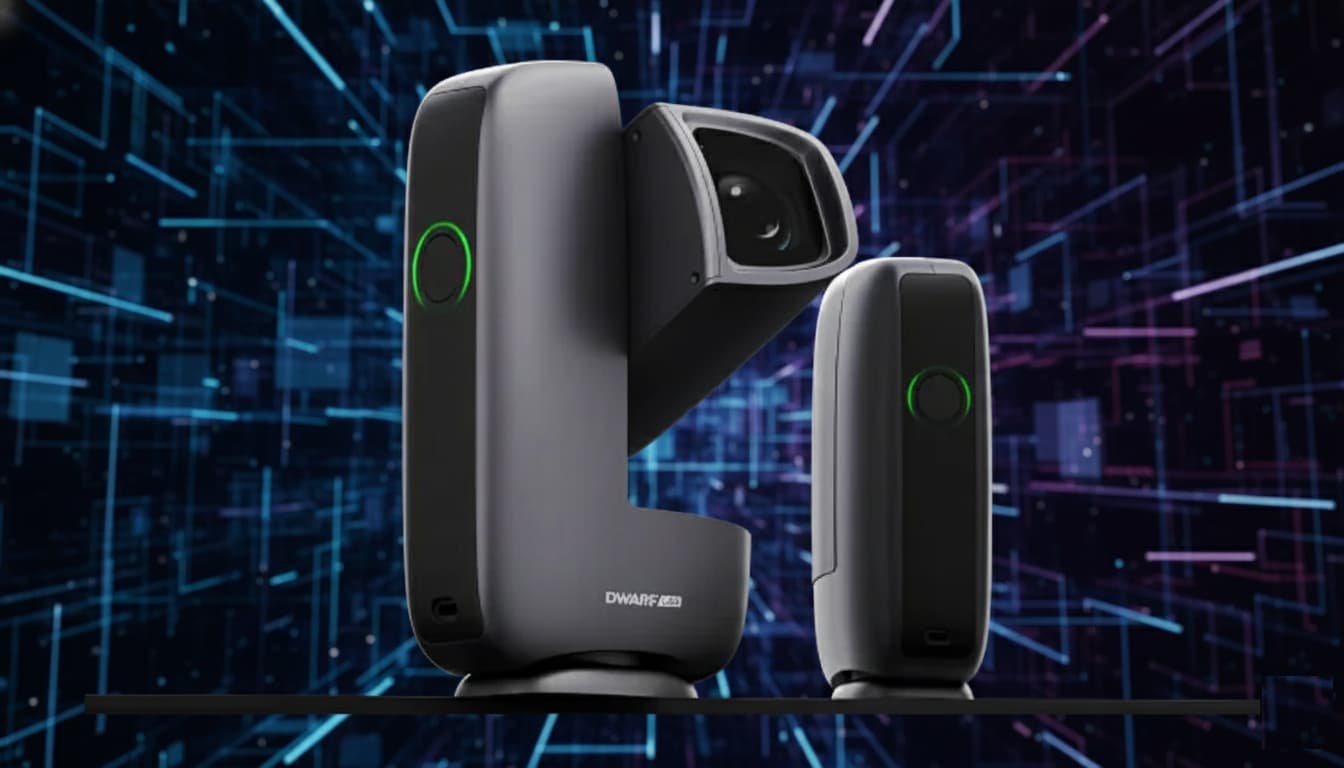
The Dwarf Mini smart telescope arrives as one of the most compact consumer astrophotography tools available. Weighing just 840 grams and priced around $400, it targets beginners and hobbyists who want fast setup, automated imaging, and simple app-based control. Its body includes a standard tripod thread for universal mounting, though a tripod is not included.
Inside the box, the unit ships with a solar ND filter, cleaning cloth, USB-C charging cable, and user guide. The telescope integrates Wi-Fi and Bluetooth for wireless communication with Android and iOS devices through the Dwarf Lab app. With onboard storage, a 7000 mAh battery, and a minimal setup workflow, users can move from unpacking to capturing images of the sky in under three minutes.
The Dwarf Mini uses a 30 mm aperture paired with a 150 mm focal length telephoto lens, giving a field of view of roughly 2.4°, about five times the apparent size of the Moon. A secondary 3.4 mm wide-angle lens with a 50° field of view assists in alignment and can also capture Milky Way panoramas.
Imaging is powered by a 2 MP Sony IMX662 sensor with three integrated filters:
Photos are saved as both individual FITS files and stacked images, while daytime media is stored as JPEG and MP4. The internal battery offers approximately four hours of runtime and can operate while charging via USB-C.
Capturing the Sun requires attaching the included ND filter to the telephoto lens. Once mounted on a leveled tripod, users simply power on the telescope, open the Dwarf Lab app, and connect via Bluetooth and Wi-Fi. The app automatically detects the telescope, shows a live view feed, and offers dual-lens preview for alignment.
Using the wide-angle lens, the Sun is centered before switching to the telephoto view. Autofocus locks onto visible sunspots, and the solar mode initiates an automatic calibration cycle. The telescope then begins live stacking — in this case, 75 exposures — combining them into a sharper final image. The resulting solar photo displays good detail for a 30 mm aperture system, and all raw data remains available for external processing.
Lunar imaging follows the same workflow. After centering the Moon with the wide-angle lens, the telephoto view takes over and autofocus sets exposure and sharpness. The app’s solar system mode triggers tracking and allows users to select stack counts, such as 20 or 250 frames.
The mini telescope closes and reopens briefly for calibration before locking onto the Moon. Stacked lunar results show noticeable improvement with more exposures, though gains diminish beyond a certain point due to the system’s small aperture. FITS files for each frame are saved for manual stacking using external software tools like AutoStakkert or AstroSurface.
For deep-sky imaging, the Dwarf Mini includes an optional EQ (equatorial) tracking mode, allowing longer exposures by aligning the telescope with the celestial pole. The app provides a guided video explaining alignment steps. Users orient the back of the telescope toward Polaris, tilt to approximate latitude, and let the mini calibrate its orientation. Even a rough alignment within 2° is enough for one-minute exposures.
Despite being placed on a simple budget tripod and facing mild wind, the Mini successfully achieved usable tracking accuracy for multi-minute stacking sessions.
Using the app’s built-in Atlas star map, locating targets such as M45 (Pleiades) is as simple as searching and tapping the object name. The telescope slews automatically and begins tracking. With 60-second exposures, astro filter enabled, and gain around 60, the Mini collects deep-sky data through continuous stacking.
A one-hour session on the Pleiades produced a clean stacked image, even under urban light pollution. Airplane trails, clouds, or satellite streaks appear in individual frames but can be removed using manual stacking workflows.
For the Andromeda Galaxy (M31), the Mini employs mosaic mode due to the object’s size relative to the sensor. The telescope alternates between two panels, capturing approximately 20 stacked frames per position. After 90 minutes, the processed mosaic displayed recognizable Andromeda structure with solid detail for a 2 MP sensor and light-polluted conditions.
The Orion Nebula (M42) and Running Man Nebula were also imaged using mosaic mode, producing quality results after about 90 minutes of exposure. The duo-band filter proved especially effective on the Heart Nebula (IC 1805), isolating emission gases and suppressing city light contamination.
While the Mini performs well for bright deep-sky and solar system wide objects, its small aperture and short focal length limit planetary imaging capability. Jupiter appears as a small disc accompanied by its Galilean moons, but surface features are not captured. Larger telescopes remain necessary for planetary detail.
The Dwarf Mini includes several advanced software features that enhance usability:
Stacked images, mosaics, and individual frames are organized neatly on internal storage for external processing in PixInsight or other astrophotography applications.
The Dwarf Mini smart telescope succeeds in delivering an approachable astrophotography experience with fast setup, automated tracking, and dual-lens convenience. While its 30 mm aperture limits fine detail, the combination of built-in filters, mosaic mode, EQ tracking, and live stacking allows users to capture the Moon, Sun, star clusters, galaxies, and nebulae with surprising clarity for its size and price.
For newcomers to astronomy or casual observers who want an easy, portable, and enjoyable imaging tool, the Dwarf Mini stands out as one of the most accessible and affordable smart telescopes available.