





Smart Discovery Store
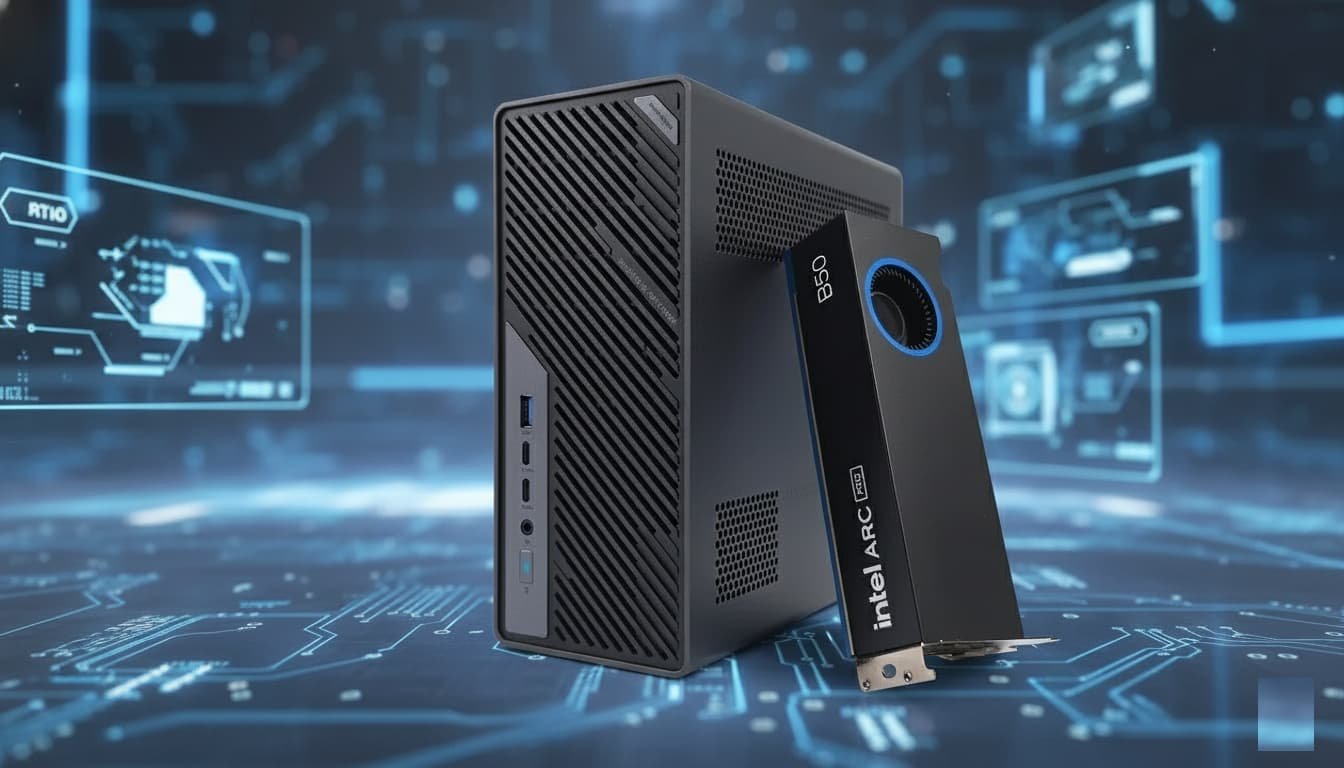
Minisforum MSO2 Ultra Mini PC – Extreme Expandability and Server-Class Power in a Compact Chassis
The Minisforum MSO2 Ultra occupies a category that few systems attempt to enter. While branded as a mini PC, its specifications, expansion options, and networking capabilities place it closer to compact workstations and entry-level servers than traditional small-form-factor desktops. This model represents a clear departure from the minimalist mini PC trend, instead prioritizing raw capability, I/O density, and modularity.
Unlike many previous Minisforum systems that leaned heavily on AMD platforms, the MSO2 Ultra marks a deliberate shift back to Intel. At its core is the Intel Core Ultra 9 285HX, a 24-core processor designed for sustained high workloads. The platform targets professionals, power users, and homelab builders who require compute density, fast networking, and flexible storage in a footprint far smaller than a standard tower.
Chassis Design and Physical Construction
The MSO2 Ultra is noticeably larger than most mini PCs, yet still compact relative to its capabilities. The aluminum enclosure feels dense and industrial, with a focus on rigidity and thermal support rather than decorative minimalism. Venting is substantial, and the overall design clearly prioritizes airflow over aesthetic subtlety.
The system includes mounting feet on multiple sides, allowing it to be positioned horizontally, vertically, or tucked into entertainment and workstation setups. This flexibility makes it suitable for use under monitors, in server racks with adapters, or as a standalone desktop unit.
Internally, the scale of the cooling solution immediately stands out. The CPU cooler occupies a significant portion of the internal volume, underscoring the thermal demands of the HX-class processor. This is not a low-power system designed for silence-first operation; it is built to sustain heavy workloads within tight spatial constraints.
Connectivity and I/O Capabilities
One of the defining characteristics of the MSO2 Ultra is its unprecedented I/O density. The rear panel alone includes an HDMI 2.1 port supporting high resolutions and refresh rates, a 40Gbps USB4 Type-C port with DisplayPort Alt Mode and power delivery, three 10Gbps USB Type-A ports, a 2.5Gb Intel Ethernet port, and an additional 10Gb Realtek Ethernet port.
The standout feature, however, is dual 25Gb SFP28 networking powered by Intel hardware. This level of networking is exceptionally rare in systems of this size and positions the MSO2 Ultra as a serious contender for enterprise labs, high-speed NAS setups, and virtualization environments.
On the front, dual USB4 v2 ports provide additional high-speed connectivity, alongside another 10Gb USB-A port, a combined audio jack, and a power button. For a system of this footprint, the total I/O offering exceeds that of many full-sized desktops.
Internal Expansion and Storage Architecture
Opening the chassis reveals a highly unconventional internal layout optimized for expansion. The MSO2 Ultra includes a PCIe Gen 5 x16 slot, a PCIe Gen 4 x4 slot, and a custom PCIe Gen 4 x12 carrier card. This carrier card serves a dual purpose: it hosts the dual 25Gb network controller and provides mounting for two M.2 NVMe SSDs.
In total, the system supports up to four M.2 SSDs, enabling configurations of up to 32TB of NVMe storage. This level of internal storage capacity is extraordinary for a mini PC and makes the MSO2 Ultra particularly attractive for high-speed storage arrays, virtualization hosts, and data-intensive workloads.
Power is supplied by a 300W Flex ATX power supply, which includes an 8-pin PCIe connector for low-profile GPUs. While GPU compatibility is limited by size constraints, supported options include professional small-form-factor cards such as the RTX 4000 Ada and select low-profile consumer GPUs. This adds significant versatility for AI inference, light rendering, or GPU-accelerated workloads.
Memory, Wireless, and Platform Features
The MSO2 Ultra features four SO-DIMM slots supporting up to 256GB of DDR5 memory. Both ECC and non-ECC configurations are supported, catering to users who prioritize data integrity alongside performance. Memory speeds are capped by platform limitations, and XMP profiles are not supported, which may disappoint enthusiasts but aligns with the system’s stability-first orientation.
Wireless connectivity is handled by a socketed Wi-Fi 7 and Bluetooth 5.4 module, ensuring modern wireless performance and upgrade flexibility. The modular nature of this component allows for future replacement if standards evolve.
Virtualization support is fully enabled, continuing Minisforum’s tradition of catering to homelab and enterprise-adjacent users. This makes the MSO2 Ultra suitable for hypervisors, containerized environments, and multi-VM workloads where both CPU density and network throughput are critical.
Performance and Thermal Behavior
In synthetic benchmarks, the Core Ultra 9 285HX delivers performance approaching desktop-class CPUs. Multi-core results place it competitively alongside high-end desktop processors, while single-core performance remains strong enough for responsive general use. In certain benchmarks, it rivals or exceeds flagship consumer CPUs, underscoring the raw compute capability packed into this compact system.
Integrated graphics performance is functional rather than performance-oriented, suitable for media playback, desktop workloads, and light graphical tasks. Gaming and advanced GPU workloads require the addition of a discrete GPU, which the system is explicitly designed to accommodate within its physical limits.
Thermally, the system demonstrates the challenges inherent in such a dense design. Under sustained heavy loads, fan noise becomes noticeable, and the cooling solution prioritizes maintaining safe operating temperatures over acoustic comfort. While short bursts of high power draw are handled well, sustained maximum power configurations push the cooling system to its limits. The platform allows aggressive power tuning, but effective thermal management becomes the limiting factor rather than electrical capability.
High-Speed Storage and Networking Performance
With multiple NVMe drives installed, the MSO2 Ultra delivers exceptional storage throughput. RAID configurations across four SSDs achieve multi-gigabyte-per-second read and write speeds, making the system well suited for high-performance file servers, media processing, and database workloads.
Networking performance over the dual 25Gb interfaces unlocks use cases rarely associated with mini PCs. High-speed NAS deployments, distributed compute nodes, and advanced homelab configurations become practical without the footprint of rack-mounted hardware. While real-world performance depends on the surrounding network infrastructure, the platform itself presents no obvious bottlenecks.
Pricing and Value Considerations
The MSO2 Ultra commands a premium price, particularly in fully configured models. Barebones options provide flexibility for users who already own DDR5 memory and NVMe storage, while preconfigured variants bundle Windows, storage, and memory at a comparatively competitive markup.
When compared to equivalent ITX desktop builds, the MSO2 Ultra offers comparable or superior performance in a significantly smaller enclosure, though at the cost of proprietary components and reduced upgrade freedom. For users who value compactness, I/O density, and enterprise-grade networking, the pricing aligns with the capabilities offered.
Use Cases and Target Audience
The Minisforum MSO2 Ultra is not designed for casual desktop users. Its strengths lie in scenarios that demand compute density, fast networking, and modular storage within constrained spaces. Ideal use cases include homelabs, edge servers, virtualization hosts, high-speed NAS systems, and compact development workstations.
For professionals who require extreme capability without dedicating space to a full-sized tower or rack system, the MSO2 Ultra represents a rare convergence of power, flexibility, and compact design.